 |
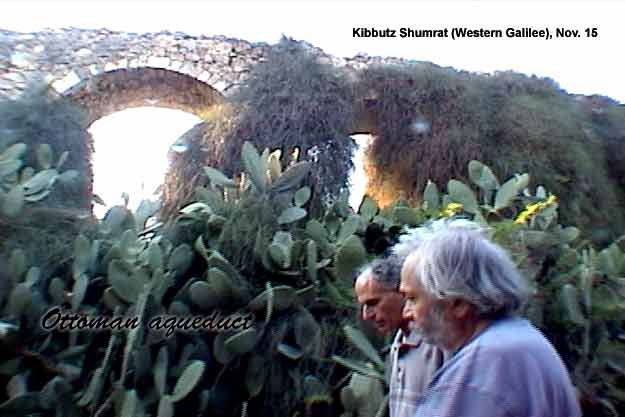
Walk along the aqueduct"We need a new mentality ... No more luftmenchen ... We’ll work the land. We’ll have our own police force, our own prostitutes and our own thieves. " After lunch we walked along the aqueduct that runs through part of the kibbutz. It was built during the Ottoman period on the ruins of a Roman aqueduct, which was probably built around the time of Justinian. So these are some pretty old rocks. Prickly pear cacti (as American as the avocados we were walking through, but thoroughly naturalized) grow along it.
We walked and talked. I asked Srul if he could tell an Arab from a Jew. "Not always," he said, if there are no distinguishing outfits and if language doesn't enter into it. Later, we saw a couple harvesting olives, and I asked him again if he thought they were Arabs or Jews. He didn't really know, but he said that the olive harvest was traditionally reserved for neighboring Arabs. The next day, I saw them harvesting at another spot and shot some footage of it. The olive harvest in this part of the world is more ancient than the old rocks we were walking along.
Transcription (edited) of video clips Peter: When you’re walking down the street in Aco, here comes somebody. Can you tell whether it’s an Arab or a Jew by looking at him? Srul: Not always. Peter: No. Srul: Not always. The give-aways are obvious. Peter: The clothes or something like that … Srul: If there’s something – you know – if they’re dressed traditionally, it’s very easy. Also, when they talk you can tell an Arab accent. When they talk in Hebrew, it’s very easy to detect an accent. Definitely easy to tell the difference – but again – not always. Look over there (pointing to a distant hill). You see a small little bit of white, almost at the crest. It looks like steps going down a bit. That’s a Crusader castle and there’s a kibbutz that’s built right around it. Srul: ... third worlders who were frustrated and jealous of the western world and every place there’s a clash there’s a problem. Michael: The one that always gets blamed is the Jew. Srul: Okay –now look – there’s some places where it’s not because of the Jew there maybe – you know – there’s always a clash. Within Israeli Jewish society, there’s the same problem. The Jews who came from the Arab countries... Peter: Oriental Jews versus the European Jews. Srul: Exactly. The same problem. Batya was talking about it a bit in the house, that they didn’t assimilate and a lot of the problem was the Jews who founded modern Israel, a hundred years ago, were Eastern European Jews, and their Jewish realm was Eastern Europe. In any event, there was this clash between the Jews coming from Morocco and the Jews who came from Poland. And the Jews who were coming from Poland were the ones who set the tone. They were the ones who founded the place. They absorbed the other Jews, and their Zionist goal was to create a new Jew, to negate the exiled Jew, the Jew of the Diaspora. We need a new mentality. We are able to defend ourselves. We’re able to provide for ourselves. No more luftmenchen – people were middlemen in making money off of other people. We’ll work the land. We’ll have our own police force, our own prostitutes and our own thieves. The thing is, a lot for the things that they took for granted were western things. In other words they didn’t negate Beethoven and Bach. When the Moroccan Jews came,instead of Beethoven and Bach, they had Arab music. A lot of these (European) Jews who were absorbing them would say to them, "that’s part of the Diaspora." The Moroccans would say, "but you’re listening to Beethoven." Or names. Let’s say the Arabs, a Moroccan Jew or an Iraqi Jew, would come to the country with an Arab name and they’d say that’s the Diaspora. You have to have an Israeli name. Change your name to Amir or an Israeli name. Who would be telling you to do that? Someone named Sonia! There was also the issue of the Eastern European Jews were not just Zionists, they were mainly socialists and anti-religious. And part of their new Jew – their new negating the Diaspora – was anti-religion. And religion was not a negative thing for the Moroccans. For the Jews of the Orient, religion played a much stronger role. Michael: This is an important distinction. Every new generation of anybody anywhere is always discriminated against. Always exploited. For the most part, it lasts a generation. Srul: Russians who came to Israel ten years ago are a lot more integrated then Moroccans who came here fifty years ago. Because they came from a somewhat western society and they felt like they were swimming in their natural territory. Michael: It’s not an institutionalized system. Srul: Well – it is and it isn’t. I’m talking about this part of it that is not institutionalized. Okay – you’re right – it’s not institutionalized. But there definitely are problems. I remember also the whole issue of there’s a big stigma to being a Moroccan Jew. To this day. Now at least a lot of the cultural aspects of it have completely disintegrated. One of the first Moroccan women who was like a newscaster has a Moroccan last name. A name that is very distinguishing. And a lot of people suggested, a lot of her Ashkenazi friends, said why don’t you change your name and she said no – I refuse to. It took a lot of courage back then. But now thanks to her it’s completely acceptable. And music – let’s say Moroccan music or Middle Eastern music is mainstream Israeli music now. It wasn’t 30 years ago. Thirty years ago if you wanted to hear music from the Yemenites or a Moroccan singer you went to the old bus station or one of the areas that only they would shop in. You’d never hear it on the radio. You’d never hear it on the television. And (today) it’s definitely integrated into Israeli culture. Food is always a problem. What I mean is a Middle Eastern diet is pita and hummus and beef. They prefer beef to chicken, prefer lean fish to a fatty carp and now most people prefer to eat hummus and pita and chicken and things like that. But let’s say what was subsidized? Bread was subsidized not pita. The carp fish was subsidized not the slimmer fish. Chicken was subsidized and not beef. Peter: The taste of the Ashkenazi and not of the African. Srul: Right. Peter: Do you know when this aqueduct was built? Srul: This is a Turkish aqueduct built like in the past maybe hundred and fifty years… Peter: Ohhh…I see… Srul: …on the ruins of a Roman aqueduct that was built maybe a thousand five hundred years ago or something like that. Peter: Probably more. By that time the Roman Empire had sort of disintegrated. Srul: I think you’re right. When we were younger we would walk along the top. Michael: What’s your opinion on what Mark said ‘I don’t trust an Arab no matter what; it’s in their blood’? Srul: First of all – I refuse to generalize. When it comes to issues like trusting another people – that’s a quality that you cannot associate with an ethnic group. Trust. I think that individuals have it – either they’re trustworthy individuals or they’re not. You have to have a degree of distrust in everybody, and you also have to have a degree of trust in everybody. But when you’re talking
about a conflict like what’s happening between us and the
Arabs, you have to also have this degree of trust. You also have
to trust the fact that the majority of your opponents – your
enemies – your whatever you want to call them – are
people who want peace and quiet also – they want a stable
lifestyle. They want to earn money. They want to raise their
children. They want to brag about their grandchildren. And
I know for sure –
I don’t know,but I assume – there are a number of
Arabs who feel that way. They want a political solution. A two
state solution. They want to feel like they’re more treated
as equals in this country. And they want to make a decent living
for themselves and feel more apart of their society. And not have
the problems that this conflict has caused. There are definitely
Arabs that feel that way and there are other Arabs who dream about
kicking us out of here, but don’t see it happening in
their lifetime. And therefore have given up. They say dreams are
one thing – but
one has to be practical. Those groups can live very well. The other
groups – the extreme – who are the ones who consider
this as Islamic land - and any land anywhere in the world that
Islam rules at one point can never be anything but ruled by Islamic
law. Or even others who for national reasons say that this is
only for Palestinians there’s no room for anybody else.
The thing is because of dynamics – because of the way things
move in a country – the environment – there’s
a lot of this dynamics of the people in the middle who under
certain circumstances they align themselves with any of those
three groups. Let’s
say that when the peace process started there was a trend of more
and more Arabs who suddenly were accepting us as a legitimate
entity in the area. Further conversationWhen we got back to Srul's place, we sat in the front yard and talked some more. Further conversation: Part 1 • Part 2 • Part 3Part 1 - Discussing kibbutz education, economics and values Srul: The Department of Education here would give a certain number of jobs. For your 300 pupils, you have, I'm just throwing out a number, 20 teachers, a staff of 20. And they'd say okay give us the names of the 20 people who are employed and who we're going to pay for their pensions and who we're going to everything else for. Michael: Those teachers are paid by the state. Srul: Right. Those teachers are paid by the state. The others were paid by the kibbutzim. Michael: So you would have the option of hiring your own supplemental group of teachers. Srul: And the problem was years, before we had pensions for everybody, we had a situation. This is one of the many discrepancies we encounter in kibbutz life. We had some teachers who are employed by the Department of Education and who had pensions and others who didn't. It wasn't a problem as long as we felt "who needs those pensions?. The pensions are going to go into the kitty anyway, so who needs them." But as soon as we realized people are going to be living off of their pensions, then we had a problem. Peter: Now you pay taxes to the government as well your share to the kibbutz. Srul: Right. Yeah. Peter: Is the tax rate pretty high? Srul: Yeah. It's very high. Don't ask me how much it is. I can throw out in general terms. Let's say right now I'm working basically freelance. In other words, the company that I'm working for doesn't pay me a salary. I give them a bill, or the kibbutz gives them a bill, and they pay me all of my expenses. With that money let's say I have to pay for my pension, my severance pay, sick leave and all these other things employers usually cover. Peter: You are a consultant essentially. What do you charge an hour? Srul: I have two different jobs. One I charge 90 shekel an hour which is a pretty good salary here. It doesn't sound like a lot. Peter: It's less than 20 dollars an hour. Srul: Yeah, it's a little less than 20 dollars an hour. And that's considered pretty good. And the other one is 60 shekel an hour which is closer to 13. Peter: Let me ask you something. You came here because you were a socialist and you were drawn to the experiment in socialist living which now you're somewhat disillusioned with. It hasn't really worked. Srul: Yeah. I'll say it like this: I consider a social democrat. I think there has to be fair distribution, or a fair safety net. People are not hungry. People have houses. People have education and health. The basic needs have to covered. There definitely has to be some sort of a mechanism to deal with people who are not doing right; the Soviet Union would call them parasites. In terms of the views here also. And also I think there are certain advantages to collective ownership of means of production but there are also a lot of problems with it. Collective ownership of means of consumption but there are also a lot of problems. And I think the combination of collective ownership but not subsidizing it a hundred percent, in certain cases of not making a profit off of them but charging people market prices for services that they're getting from themselves. Like in the past, if I needed a chair repaired I'd call the carpenter. He'd fix it and go. And now if he comes and fixes something I have to pay him for an hour of work or whatever. The kibbutz is not making a profit off of that hour. It's basically covering his costs and that's what I'm being charged. His costs. And I think that this is a good system. I also say that, back to what I was saying before, the importance of community. The fact that we have a community with a degree of interdependence with a degree of a common fate, common history, a lot of us came from the same movement background, there's something very good there. When we were raising our kids and one evening our daughter, this was after we moved over to the new system, she didn't come home at night. She didn't sleep at home. And we went to bed and we didn't worry about it. We said to ourselves she's either at this friend's or that friend's. In the morning we'll scold her. We'll tell her she has to let us know where she is. But it's already too late to look for her. We went to sleep and slept soundly. And that's because we live in a community that we can feel that sort of security with. When we need some margarine, we're out of it, we'll go over to a neighbor. And if the neighbor isn't home and we know where the key is we'll go in and if we see that they have enough we'll take it and they do the same with us. A few days ago Ora and I were out walking. We came back and just as we were a minute away from the house I got a phone call. It was a friend of ours calling us. She said where are you? We said we're on our way home. She said well I'm in the house. I thought you'd be here. I made myself a cup of coffee. These are the luxuries that you pay a price for. And I'm willing to pay that price because it's a nice system. I think that a lot of problems of humanity are based on the fact that people do not have a community that they can fall back on. That they can identify with, they can feel a part of. Whether or not that community has to be egalitarian or a collective, that doesn't have to be. That's not the important issue. Part 2 - Kibbutz changes Srul: I'm complacent. Michael: You liked it the way it was. Srul: I liked it the way it was. I'm happy it changed. I count my blessings that there were other people who were dissatisfied with the old system who made these changes. I wouldn't have been one of the first parents who took their kids out of the children's houses before we'd made a democratic decision to do that and move their kids home no matter what the kibbutz decides. I wouldn't have been one of those. But I it was a good change that we did that. I also opposed the incentive system, which we have now. For years. I accepted it in the end. Michael: What do you mean the incentive system? Srul: A portion of your salary gets back to you. In other words, whatever is earned - let's say 9,000 which is 4,000 above your safety net, then you get 40% of that. You know, it's not a lot. In other words, there still is a small gap between the high earners and the low earners. Part 3 - Family left at home Peter: Did it ever cross your mind that as a technical writer, a couple of professionals in the family, that if you moved back to the states you could make a lot more money, you wouldn't have to deal with the physical and military threats, the hostility in the society? Srul: Yes. Peter: It has crossed your mind. Srul: It's crossed our minds a number of times. In the recent past, we have basically come to the realization that we missed the boat. I don't want to give that the connotation that we regret that we're here. Peter: But you missed your window of opportunity. Srul: Our kids are already older. They're independent. If we moved back, our kids have their friends, their partners already, they aren't necessarily going with us. Our youngest son is in twelfth grade. He would be with us for sure. But the older two, not necessarily. So, we would be basically doing to our children what we did to our parents. A number of our friends did it. Say 10 ten years ago, 15 years ago, they were here on the kibbutz 10 to 15 years, 20 years some of them, and they left. The kids were young enough. They did it as a family and most of them are very successful now. When I came here, the main thing that I felt I was sacrificing was my close connection with my family. I liked the hiking and camping in California , in the United States . There's nothing you can do that's anywhere the equivalent to that here. Nothing. And that for me was a sacrifice. But that was compensated. You can compensate by a different type of hiking and camping here. And there is. And different types of experiences, which I've had. But, there's not compensation for leaving your parents or leaving your brother. Peter: How many times have you been back to visit? Srul: In the earlier years, right after we got married, 1976, a year after we got married, we were back. And then, about every five years or so we went on a trip. And after my dad's stroke I went back every year. Peter: Your mom's still living, isn't she? Srul: Yeah - oh yeah. Peter: But your dad died. Srul: Yeah, he died. About two and a half years ago. Mom has Alzheimer's. She's in a facility which is a great place. Shacher I know from day one. His mother and my mother were pregnant together with us. From then on we've been friends. He was here until about 12-13 years ago. Peter: Came with you? Srul: Yeah. He came a year later. Luckily, there's email. You know this is a real knife in the heart for me. To lose the closeness with him and a number of other friends. A number of my closest friends have left. Peter: You think your children will stay? Srul: That's a good question. Let's say another change that went by the kibbutz: We used to have a lot of volunteers from outside of the country would come and work on the kibbutz and add a lot of life to the younger crowd. Peter: Like young Jews would spend their summer in Israel working on a kibbutz. Srul: Jews and non-Jews from Denmark and Sweden and Switzerland or whatever they'd come and in a number of cases the children of the earlier members that were my age, a couple of them are living in United States and Europe, because they married these volunteers. We don't have any more volunteers. And our children, their friends, their potential spouses, are Israelis. So, it's less likely that they're going to pick up and leave. They have American and Canadian citizenship. Peter: By virtue of their parents? That's interesting. Srul: So they can choose. And, if they do get married and they do decide to leave they can take their spouses with them and it shouldn't be a problem. Just last night I was talking to Tamir abou it. His politics were really affected by the past two years of the intifada. He says that if we go to war here and lose 80% of our population. I'm still here. But, if the next day an ultra-orthodox person becomes the prime minister, that same day I'm leaving.
|

HOME
BIBLIOGRAPHY
LINKS
Going to
Israel
What Michael thinks
What Peter thinks
Video Notes
Guest Book
TEL AVIV
Nov. 10-13
- Capt. Dan Tamir
- David Rubin
- Serge Samuel
- Abraham Huli
- Col. Yoash Tsiddon - Chatto
- Ronen Zadoc
- Joshua Shushun
- Ran HaCohen
WESTERN GALILEE
Nov. 14-17
- Elias Chacour
- Srul Alexander
- Mark Erlank
- Aqueduct
- Yehuda Benin
- Acco
- Yaacov and Chaya Oren
- Dr. Nasser Gadban
- Safi
JERUSALEM & RAMALLAH
Nov. 18-23
- Elana Rappaport Schachter
- Tova Saul
- Talal
- Sam Bahour
- Dr. Mustafa Barghouti
- Keren Mulag
- Arak Kilemnic
- Jeff Halper
- Shabbot dinner
- Sami Taha
TEL AVIV -
Nov. 24
- Tel Aviv restaurant owners
- David Libon
- Grazia